
Why did I need another dashboard?
Good question.
Maybe the coffee just hit extra strong this morning. Maybe I wanted something cool sitting on my wall. Or maybe I was tired of opening five different tools just to get a basic feel for how the business was doing.
At ActionVFX, the stuff I care about during the day lives all over the place: revenue, orders, subscribers, product activity, engineering work, errors, open tasks, analytics, and a few strategic things we are watching.
None of that is impossible to find. It is just scattered.
So I built a wall-mounted CTO dashboard with my agents in Claude Code and Codex, using internal ActionVFX skills for branding, UX, code standards, and analytics.
The goal was simple: one screen I could glance at during the day and know if anything looked weird.
How I built it
I started with the shape of the thing, not the tech.
I did not want a generic chart wall. I wanted it to feel like an ActionVFX internal product: dark styling, large numbers, short labels, rotating slides, and clear source-health indicators when something was missing or stale.
The secret sauce was giving the agents better taste and better constraints. I used my internal ActionVFX brand standards and design skill, then leaned on Impeccable to keep the UI from sliding into the usual AI dashboard slop.
The agents handled a lot of the mechanical work: setting up the Next.js app, building data adapters, wiring up the UI, adding basic auth, cleaning up environment files, checking builds, and getting the project ready to deploy.
I still had to steer it pretty heavily.
That has been the pattern with most agentic development work for me. The agents are good at moving fast, but they will happily drift toward “generic SaaS dashboard” if you do not keep pulling them back toward the actual product you want.
I wrote more about that split in If it’s obvious an agent did the work, you’re doing it wrong.
For this one, I kept pushing toward a simple wall display I would actually look at during the day.
The result
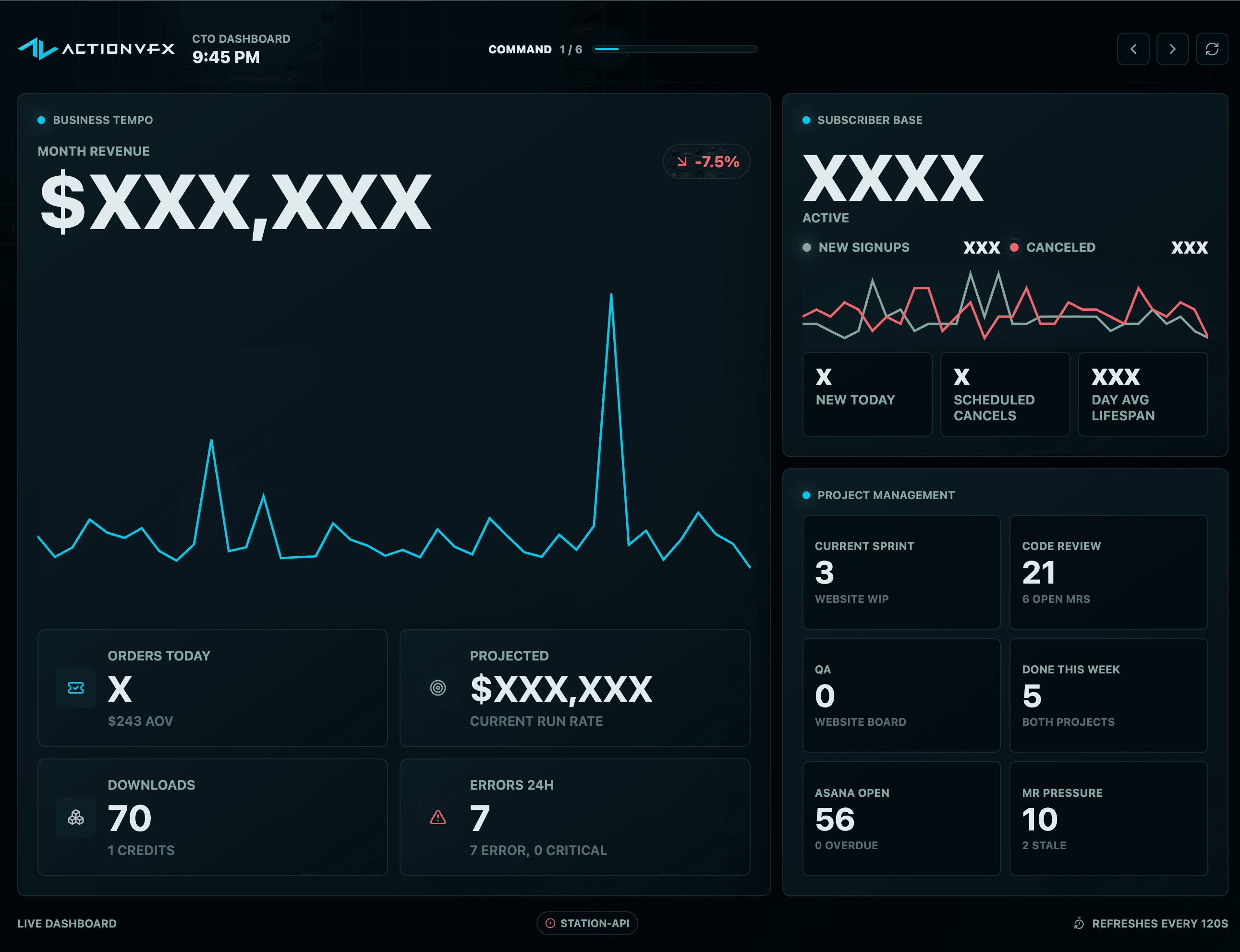
The dashboard now pulls together the signals I care about most: business performance, subscriber health, product movement, engineering flow, reliability, and a few current initiatives.
It runs as a small Next.js app on Vercel. Private data access happens server-side, and the browser only gets the cleaned-up dashboard payload it needs. I added basic password protection because “internal tool” is not a good enough security model by itself.
Deployment was pretty painless. I had it running on a custom domain in Vercel in under ten minutes once the app was ready.
The whole thing took a couple hours of agent time and maybe 20 to 30 minutes of my actual attention.
And honestly, it is pretty cool.
Not every metric needs a formal BI project. Sometimes you just need a focused little screen on the wall that tells you what is happening while your coffee is still hot.